What Separates a Yard That Thrives From One That Just Survives

Drive through any Seattle neighborhood in late summer and the difference is obvious. Some yards look genuinely healthy — dense, green lawns, planting beds that are full and clean, everything clearly under intentional care. Others look like they’ve been fighting the season and losing.
The gap between those two yards rarely comes down to money spent on plants or a single big landscaping project. It comes down to one thing: consistent, professional maintenance.
The yards that hold up year after year aren’t maintained by homeowners who found some secret — they’re maintained by homeowners who stopped treating yard care as something to catch up on and started treating it as something to stay ahead of.
Seattle’s Climate Rewards Consistency and Punishes Neglect
The Pacific Northwest climate is uniquely unforgiving when it comes to outdoor maintenance. The wet winters create ideal conditions for moss, fungal disease, and soil compaction. The dry summers — far drier than Seattle’s reputation suggests — stress lawns and plants that weren’t properly prepared in spring and fall. The transition between those two extremes is exactly when deferred care becomes visible. Moss is perhaps the most telling example. It moves fast in Seattle lawns, especially in shaded areas or wherever the turf is thin. A lawn that wasn’t aerated and treated in fall will have measurably more moss by March than one that received proper attention. By the following summer, that moss has crowded out enough grass that the lawn needs serious intervention rather than routine care.
The same pattern plays out in planting beds, in tree and shrub health, in drainage performance, and in the overall resilience of the yard through weather extremes. Seattle’s climate amplifies the consequences of skipped maintenance quickly — and consistently rewards the homeowners who stay on top of it.
The Four Seasons of Professional Lawn Care
Understanding what professional lawn care actually covers across a full year is what shifts the perspective from “nice to have” to genuinely essential. It isn’t just mowing. It’s a coordinated sequence of care that builds on itself season after season.
Spring sets everything in motion. After winter, lawns need fertilization timed to active growth — not too early, not too late. Thin or bare patches need overseeding before weeds claim the space. Beds need debris cleared, edges recut, and fresh mulch applied before the growing season accelerates. Irrigation systems need inspection, controller schedules updated, and any winter damage repaired before dry weather arrives.
Getting spring right is the single most important factor in how the yard performs from May through September. Homeowners who invest properly in spring care spend the rest of the growing season maintaining momentum. Those who skip it spend the rest of the season trying to recover.
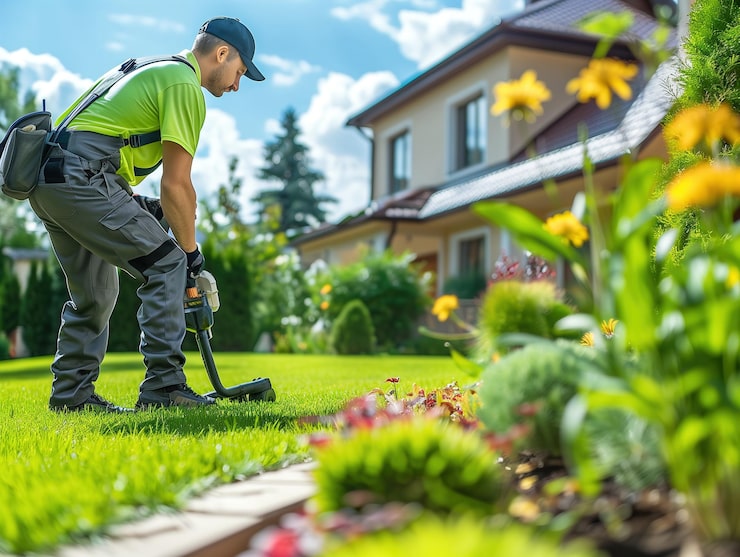
Summer is about protecting what spring built. In Seattle’s dry stretch, lawn care means mowing at the right height to retain soil moisture, monitoring irrigation performance, and catching pest or disease issues before they spread. Mowing too short is one of the most common homeowner mistakes — it stresses the turf, reduces drought tolerance, and opens gaps for weeds to establish. A professional team mows at the height the grass actually needs, not the height that looks tidiest from the curb.
Fall is the season most homeowners undervalue. It is, without question, the most important time in the entire maintenance calendar — and the one most commonly skipped because summer is winding down and attention drifts elsewhere.
Aeration breaks up the compacted soil that Seattle’s clay-heavy ground develops over a growing season, restoring the air and water movement that root systems depend on. Overseeding fills in thin areas with fresh turf before winter sets in, so the lawn emerges in spring denser and more competitive against moss and weeds. Protective mulching insulates planting beds through winter temperature swings. Irrigation winterization protects lines and valves from freeze damage that would surface as expensive repairs come March.
The lawns that look the best in April are almost always the ones that received thorough attention the previous October.
Winter is quieter but not empty. Seattle’s heavy rainfall season reveals drainage issues that weren’t visible in summer. Moss establishes quickly in neglected areas. Dormant pruning on trees and shrubs — cleaner, less stressful to the plant, and structurally more accurate without foliage obscuring the branch architecture — is best done now. A professional team keeping an eye on the property through winter catches small problems before they grow into costly ones come spring.
Why Consistent Care Compounds Over Time
This is the part that changes how most homeowners think about professional maintenance: it compounds.
A lawn that’s aerated, overseeded, and properly fertilized every season gradually becomes denser, more disease-resistant, and more drought-tolerant — not because of any single treatment but because each year’s care builds on the year before. Soil health improves. Root systems deepen. The turf becomes genuinely resilient rather than just surviving from one season to the next.
Planting beds that are consistently mulched and maintained develop better soil biology, retain moisture more efficiently, and support plant growth that visibly improves year over year. Trees and shrubs that receive proper seasonal pruning develop strong structure and perform better than those pruned reactively whenever a problem becomes impossible to ignore.
The inverse is equally true and just as powerful. Deferred lawn care compounds too — just in the wrong direction. Moss that wasn’t treated last fall is twice as established this spring. Irrigation damage that wasn’t caught in the fall inspection costs three times as much to repair after a winter of freezing. Soil that wasn’t aerated this year is harder to rehabilitate next year.
This is precisely why framing matters. Professional maintenance isn’t the cost you pay when something goes wrong. It’s the investment you make to prevent things from going wrong — and to protect the larger investment your outdoor space represents.
Conclusion
The homeowners with the best-maintained yards in the Seattle area rarely found their landscaping team through an ad. They found them through a neighbor’s recommendation, a friend’s referral, or a conversation over a fence about who takes care of the yard next door.
Word of mouth is the dominant currency in this industry because maintenance is a relationship, not a transaction. The team that knows your property — understands which corner drains slowly, which bed gets too much afternoon sun, which area the dog runs through every morning — delivers fundamentally better care than one treating it as an anonymous service call.